


The Argentine director shared details behind his four-decade relationship with the play Parque Lezama, from Herb Gardner’s original version to the film adaptation, which will soon be released in theaters in Argentina and worldwide on Netflix.
For Argentine director Juan José Campanella, the premiere of Parque Lezama as a is the culmination of a project that began four decades ago, in 1985, when the Argentine director saw the original version of Herb Gardner’s Broadway play, I’m Not Rappaport, as a spectator.
“It was my first year studying film in New York, and I went to see I’m Not Rappaport because I loved Gardner, the author of One Thousand Clowns,” recalled the award-winning director and screenwriter at a press conference organized by Netflix during the last edition of Content Americas. “I went to see it out of curiosity, and it turned out to be one of the plays that changed my life; it influenced me a lot with its style.”
With a lot of effort, the then-student managed to save up enough money to see it two more times: “For some reason I don’t know, old characters always attracted me, and even then, I thought about how Central Park resembled Lezama Park,” he said. “From then on, I began working on adapting it in Argentina.”
Convincing the author was no easy task: born and raised in Brooklyn in a traditional Jewish family, Gardner was convinced that the play should be set in Central Park. In addition, he insisted that his original script be respected, which included a Jewish character and a black character, which, for demographic reasons, “was not credible” for Argentina, Campanella shared.
It took years of negotiation, but eventually the passion of the Argentine director, who won an Oscar for The Secret in Their Eyes, paid off: Parque Lezama premiered in 2013 with a script that reimagined the characters as Antonio, a communist militant played by Luis Brandoni, and León, a conformist janitor played by Eduardo Blanco. Parque Lezama has had almost 1,200 performances over 11 years, most of them at the Teatro Politeama, owned by Campanella.
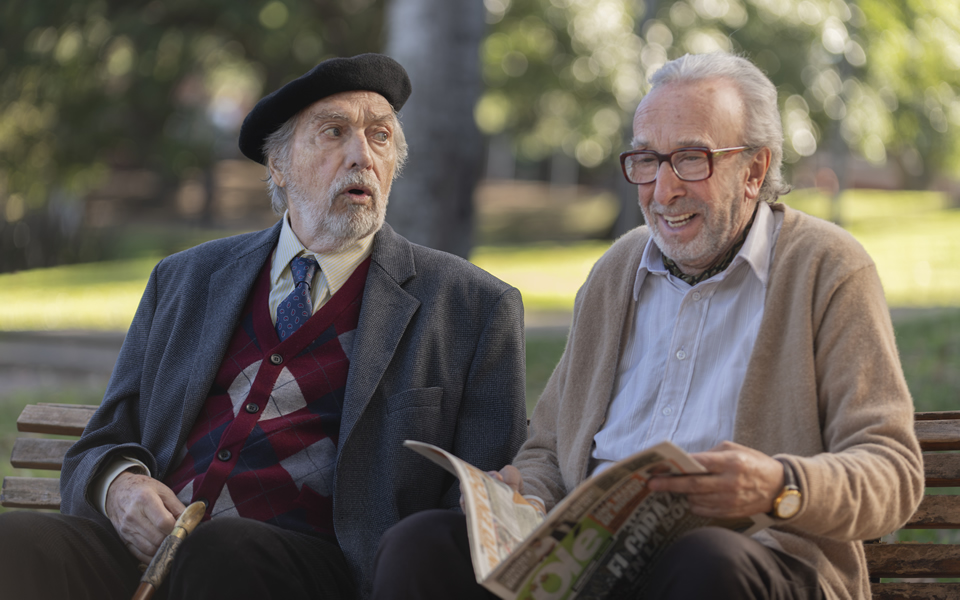
The Argentine director had complete confidence in the play’s potential on the big screen and found the ideal partner in Netflix. In 2024, he invited Francisco Ramos, VP of content for the platform in Latin America, to see one of his performances at the Politeama. As soon as the performance ended, “from the sidewalk outside the theater,” Ramos called Campanella to set his adaptation in motion.
With the same two lead actors and produced by 100 Bares, with Campanella as director and screenwriter, the film will hit select theaters in Argentina on February 19, prior to its world premiere on Netflix on March 6.
In addition to what you have already highlighted, how was it adapting the play for Argentine audiences?
Fortunately, time has kept the original play completely relevant. There is no need for temporal changes, but there is a strong adaptation to Argentina. There is also an adaptation in the growth of Antonio’s character to make them both peers, because for me, in the original play, León’s character is clearly the protagonist.
How were the central themes of the original transferred to the Argentine version?
For me, the main theme was not old age, but rather the debate between conformity and commitment. That’s why I also needed both characters to have the same importance, because that was the main conflict. Old age simply adds urgency to all the problems they go through, because there is little time left to decide whether to commit or conform, but the main theme was the other one. For me, it’s a very important play, a very profound play, but at the same time, it made me laugh a lot; it achieved that magic of making you cry with emotion and laugh at the same time, something I’ve always sought in my work. Nothing in the play needed to be adapted, apart from a few references to time, nothing else. Time kept it current, I would even say that it was more current than it was at the time.
When did you realize it could be adapted for the cinema?
Towards the end of its run in the theater. At the Politeama, I always watched it from the back row, which I thought was best for my work as a director, but when we were about to finish, I decided to go and watch it from row 5, and that’s where I discovered the close-up of the play; I discovered things I was missing and that cinema can contribute.
What are the advantages and risks of adapting a play for the cinema?
I think that when theater works, it’s a more emotional experience than cinema, but it doesn’t have the permanence that cinema offers and the cinematic factor of the close-up. Of course, there is the risk that it will be too theatrical, especially in this case, which has a lot of dialogue, but Parque Lezama is absolutely dynamic, in an open space like the park, with city life and everything that the place has to offer. We saw the film in the cinema, and I feel that all the emotional aspects were enhanced.
Do you feel that this is the end of a work that you have been involved with for forty years?
Yes. When you’re working on something, it’s like a doctor in intensive care: you go into doctor mode and don’t think about the fact that there’s a person who could die, I imagine. But for everyone, especially Beto (Brandoni) and Eduardo, it has been a tremendous finale. I think it will be a very strong legacy for Beto because they would not hesitate to say that it is one of the three best characters he has played in his life. He did not spend eleven years with any other work. I think this character, the one in Convivencia, perhaps the one in Esperando la carroza, have been very iconic and represent a spectacular legacy for him.
How was this first experience working with a platform like Netflix?
I really loved the experience I had and am having with the Netflix team, both in Parque Lezama and Mafalda. Many things have changed with streaming, and some are for the better, such as not having to adapt to a fixed duration, as I experienced with Law & Order, where you have to last 40 minutes and you can only go over by 20 seconds, or be 20 seconds shorter, nothing else. In that sense, the freedom is tremendous. When it comes to television, I think platforms have greatly improved the product, with the exception that now everything is niche: there are no really popular programs or ones that generate explosions like before, since they are limited by the users of each platform.
What can you tell us about Mafalda?
With Netflix, we’re working on this animation project, the biggest we’ve ever undertaken, and the one with the most responsibility and psychological weight, which is the adaptation of Mafalda. Mafalda is an icon for millions of people, myself included, to the point that when you’re working, you try to forget about it, or the responsibility can become paralyzing. We’re not thinking that Mafalda is going to be seen in more than 200 countries around the world. No, we’re not thinking about it, but we’re very aware of it. We feel incredible pride in this project, but we try to forget [what it means].
Speaking of trends in our industry, do you have an opinion on vertical formats?
I find them horrifying. I hope they don’t get mad at me, but I don’t wish them any success. I don’t understand why you can’t just turn your cell phone. It’s unnatural. That’s not how vision works. If it were natural, cinema would have moved toward taller screens instead of wider ones, as it did.
About Parque Lezama
Release date: February 19 in select theaters in Argentina and March 6 on Netflix.
Synopsis: Parque Lezama is a comedy that tells the story of the unlikely friendship between a longtime Communist Party activist and a lifelong believer in “don’t get involved.” From a bench in Parque Lezama, Antonio Cardozo and León Schwartz share conversations full of laughter, tenderness, and emotion as they face conflicts with characters in the park and with their own families. The film is a cinematic adaptation of the successful Argentine play Parque Lezama, based on I’m Not Rappaport by American playwright Herb Gardner.
Director: Juan José Campanella
Screenwriter: Juan José Campanella
Producers: Muriel Cabezas, Laura Eliosof
Cast: Luis Brandoni, Eduardo Blanco, Verónica Pelaccini, Agustín Aristarán, Manuela
Menéndez, Alan Fernández, and Matías Alarcón.