
The 2026 World Cup Confirms the Rise of Sports Creators as the New Media
As YouTube cements its position as the largest distributor of TV viewing in the United States, the 2026 FIFA World Cup is showing how sports creators are redefining the relationship between audiences, broadcasters and platforms.
-
By Rosa Fuentes
- 02/07/2026

Traditionally, acquiring the broadcast rights to a FIFA World Cup was considered the ultimate passport to success in the audiovisual business. Whoever held the rights was expected to have the greatest opportunities to monetize the event. Today, however, the business has undergone a dramatic shift that has caught many rights holders by surprise: audiences are increasingly choosing to experience the pre-match coverage, live reactions and post-game analysis in environments driven by entirely different dynamics.
The 2026 FIFA World Cup is becoming the clearest demonstration of that transformation. While major broadcasters continue to command the largest live match audiences, a new generation of digital creators is attracting millions of viewers before, during and after every game, building communities capable of competing with traditional media for fans’ time and loyalty.
This is not merely a Latin American phenomenon. It is a broader industry shift already recognized by companies such as Nielsen, Deloitte and YouTube itself, whose executives argue that creators are shaping a new era of the media and entertainment industry.
YouTube Is No Longer Just a Platform—It's Becoming a Television Giant
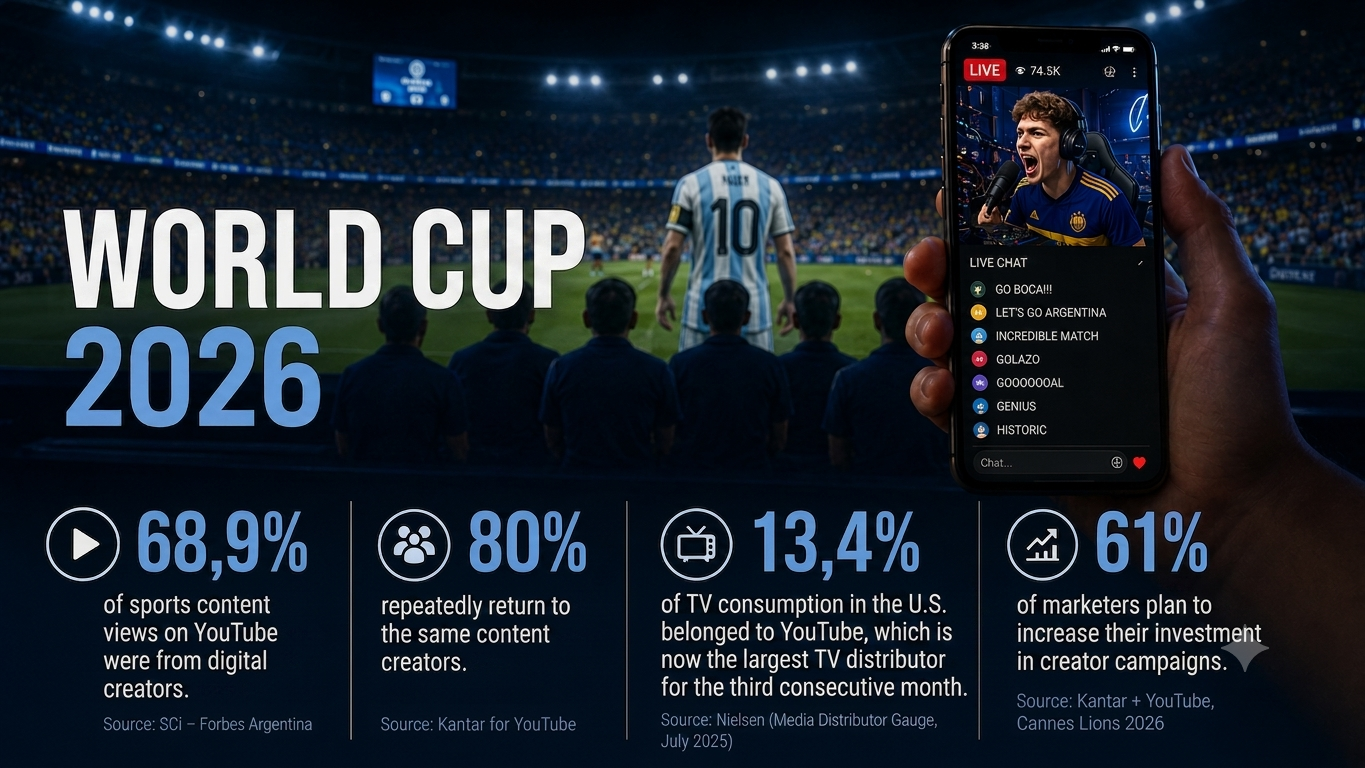
According to Nielsen’s Media Distributor Gauge, YouTube became the largest distributor of television viewing in the United States in 2025, surpassing legacy media groups such as Disney, NBCUniversal, Paramount and Netflix. In April, it accounted for 12.4% of all television viewing time, and just a few months later expanded its lead to 13.4%—the highest share ever recorded since the index was launched.
Those figures help explain why the growth of sports creators can no longer be viewed simply as a social media phenomenon. Increasingly, YouTube is being consumed on the living room television, competing directly with traditional broadcasters for viewers’ screen time.
YouTube CEO Neal Mohan reinforced that message during his keynote at Cannes Lions 2025.
“Creators are the startups of Hollywood,” he said, describing a new generation of creative businesses capable of producing premium content, building audiences and developing sustainable media companies. During the same presentation, he summarized YouTube’s vision with another striking statement: “Creators are building the new television.”
Mohan also revealed that viewers now watch more than one billion hours of YouTube content every day on television screens, and that television has become the primary viewing device for more than half of the platform’s 100 most-watched channels.
The World Cup Puts Numbers Behind an Ongoing Shift
According to a report by SCi (Streaming de Contenidos de Iberoamérica), published by Forbes Argentina, 68.9% of all sports-related YouTube views during the first week of the World Cup were generated by native digital creators, while traditional media accounted for the remaining 31.1%.
Among the standout performers was Argentine creator Davoo Xeneize, who topped the regional ranking with 132 million views. In Brazil, the trend reached an even greater scale through CazéTV, the project led by Casimiro Miguel, which accumulated 677 million views during the same period, according to SCi’s analysis.
Rather than signaling a direct battle against television, the data illustrates how creators have become a new layer of distribution and conversation surrounding major sporting events.
Brazil Offers a Glimpse of the Future
If there is one market that offers a preview of where sports consumption is heading, it is Brazil.
During the World Cup, CazéTV once again broke digital audience records, reaching 18.5 million concurrent connected devices during a Brazilian national team match. At the same time, TV Globo attracted more than 56 million viewers, demonstrating that the growth of streaming does not necessarily come at the expense of traditional television.
The coexistence of both models reflects an increasingly common reality: fans no longer consume only the match itself. They also seek tactical analysis, live reactions, commentary from their favorite creators, podcasts, clips and behind-the-scenes content. The game lasts 90 minutes. The conversation lasts for days
The New Attention Economy
According to Deloitte, this evolution reflects a much deeper transformation within the sports business.
In its 2025 Global Sports Industry Outlook, the consultancy argues that competition for fans’ attention has intensified, requiring sports organizations, media companies and platforms to invest not only in media rights, but also in digital experiences, data-driven strategies, complementary programming and new ways of engaging with communities.
Content that was once considered secondary—analysis shows, podcasts, watchalongs, documentaries, social media clips and alternative broadcasts—is increasingly becoming a strategic asset capable of extending the commercial life cycle of every sporting event.
Monetization is no longer concentrated exclusively around the live broadcast. Instead, value is being created across the entire ecosystem of content surrounding the game.
The Value Is No Longer Limited to Broadcasting the Match
Another key finding from Nielsen’s Global Sports Report 2025 helps explain why this transformation matters so much for advertisers and rights holders.
The report identifies an accelerating diversification of sports consumption and concludes that audiences are becoming increasingly multiplatform. Global events such as the 2026 FIFA World Cup represent opportunities to reach new audiences through strategies that integrate television, streaming, digital platforms and content creators.
Within that ecosystem, creators are no longer simply independent commentators. They have become distributors of attention. They build loyal communities, generate continuous engagement and extend the commercial relevance of sports rights long after the final whistle.
A Business That Has Already Changed
Television remains the primary destination for live sports, and media rights continue to represent the industry’s most valuable asset.
But the 2026 FIFA World Cup confirms that the business no longer begins and ends with the match itself.
Audience attention is now distributed across multiple screens, platforms and personalities. Broadcasters still own the rights; creators increasingly own the conversation.
Rather than replacing one model with another, the industry appears to be entering a new phase—one in which long-term value will depend not only on who broadcasts the event, but also on who succeeds in engaging audiences before, during and after every match.