
Broadcasters and Streamers: The New Friend Zone?
As the “streaming versus TV” narrative continues to lose momentum, the global audiovisual industry is moving toward a hybrid and collaborative model. Broadcasters and platforms have found in strategic partnerships a way to share risks, expand audiences, and sustain the business at a global scale.
-
By Rosa Fuentes
- 27/05/2026

The restructuring of the global audiovisual business architecture now seems inevitable. After years of speculation that free-to-air television could collapse under the rise of streaming platforms, the industry began to realize that streaming itself was also facing challenges: pricing, content value, and increasing competition.
In 2026, a hybrid view of the business — and alliances between traditional television and streamers — has become part of the industry’s ongoing search for sustainability. This is not about a truce or anyone admitting defeat; it appears to be something far more structural and mutually beneficial. Could this be the industry’s new friend zone?
The market is now seeing partnerships that once seemed unthinkable. TelevisaUnivision joining forces with Hulu, DirecTV, and YouTube TV; Comcast’s NOW TV Latino bundle integrating linear channels, ViX Premium, Peacock, FAST channels, and sports into a single package. These are perhaps the most architecturally sophisticated examples so far, and they are increasingly being viewed as benchmarks by the global industry.
Latin America is also embracing the trend. Rather than operating broadcast television and streaming as separate businesses, Globo began unifying its entire structure around Globoplay. The company even gradually phased out the Canais Globo brand to consolidate all its products within a single streaming experience.
In Argentina, Telefe understood earlier than most the value of complementary streaming and has been developing a particularly interesting strategy. The partnership between Telefe and Luzu TV to boost La Voz Argentina became one of the most talked-about cases in the regional market. The significance of the move is substantial because it shows how a traditional broadcaster stopped viewing native streaming players as a threat and instead began using them as audience expansion tools.
Telefe understood something fundamental: younger audiences did not necessarily abandon traditional content; they simply changed the way they consume it.
In Chile, Canal 13 began building a different yet equally convergence-driven strategy. Through its 13Go platform, the broadcaster developed a digital ecosystem featuring multiple linear channels and OTT content. But perhaps its most interesting move was the launch of América Vivo, a platform targeting the international Hispanic market and aiming to integrate Latin American broadcasters within a shared digital environment.
At the same time, regional integration initiatives among Latin American broadcasters are also beginning to emerge. One recent example is ALATV, developed together with DirecTV and Non Stop Studios, bringing together companies such as Telefe, TV Azteca, América TV, Canal 10, Telefuturo, RCN, and Unitel.
The Exhaustion of the Confrontational Model
To understand why this convergence accelerated, it is first necessary to understand why the logic of confrontation ran out of steam. During the most aggressive years of the streaming wars, the implicit promise was that the global scale and seemingly unlimited budgets of major platforms would eventually erode the foundations of traditional broadcasters.
The numbers appeared to support that narrative: Netflix, Disney+, Amazon Prime Video, and Apple TV+ accumulated hundreds of millions of subscribers in record time. Linear television audiences declined. Advertising dollars shifted elsewhere. Everything seemed to confirm the prevailing storyline.
But the model began to reveal its limits — brutally. SVOD growth started to slow. Production costs continued to rise. Wall Street began demanding profitability where it had once rewarded growth at all costs.
At the same time, the market’s extreme fragmentation produced an unexpected phenomenon: consumers, overwhelmed by subscriptions and fatigued by the proliferation of platforms, began behaving in ways that no purely streaming-based business model had fully anticipated.
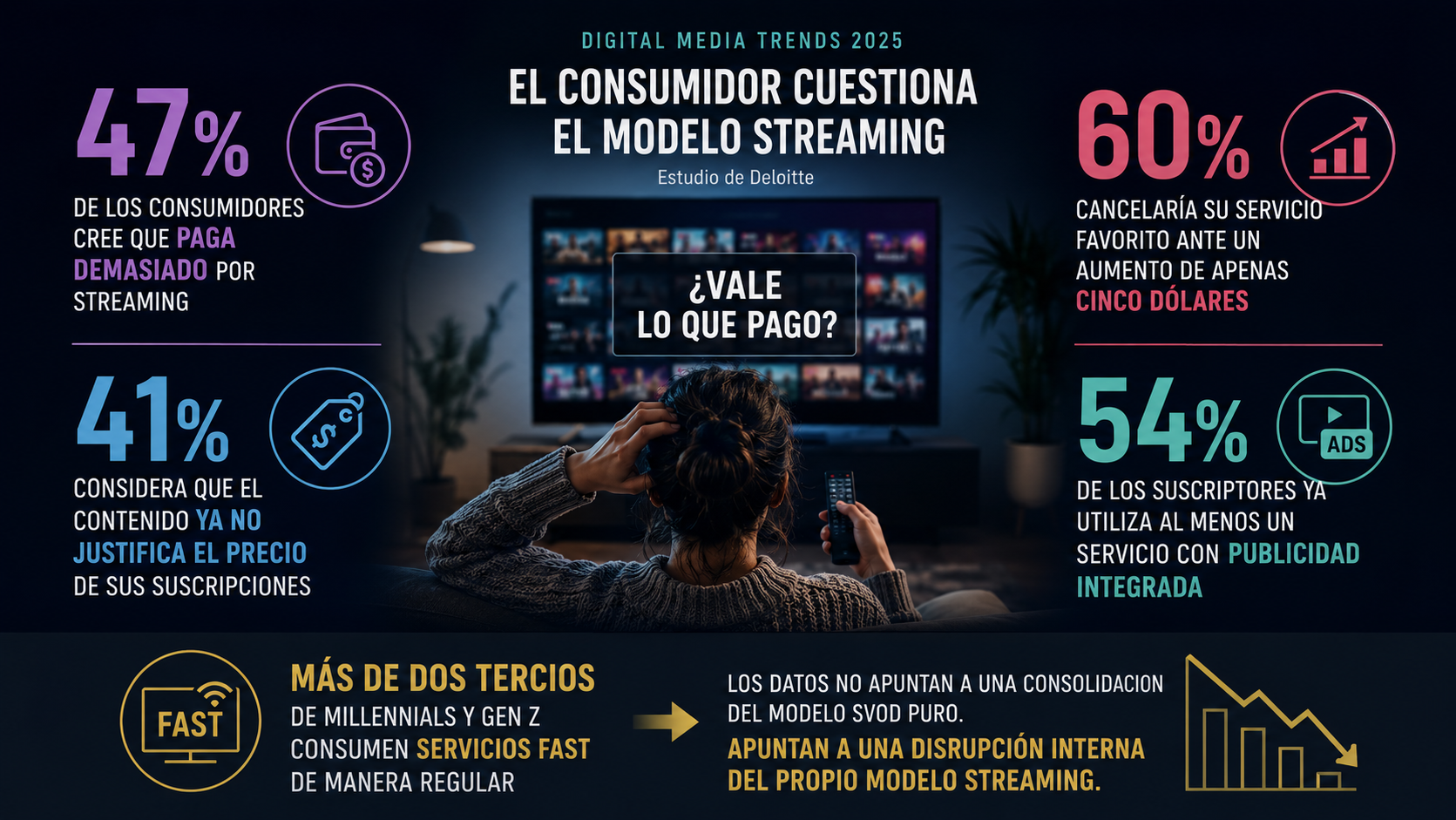
Deloitte’s Digital Media Trends 2025 study delivered an uncomfortable snapshot of the situation: 47% of consumers believe they pay too much for streaming services, while 41% feel that the content no longer justifies subscription prices.
Sixty percent said they would cancel their favorite service following an increase of just five dollars. Meanwhile, 54% of subscribers already use at least one ad-supported service, and more than two-thirds of millennials and Gen Z viewers regularly consume FAST services. The data did not point toward a consolidation of the pure SVOD model. Instead, it pointed to something closer to an internal disruption of the streaming model itself.
The TelevisaUnivision and Disney Case: A Defining Example
Concrete deals are what truly reveal the market’s direction, and over the past few months they have accumulated with a consistency that makes the pattern difficult to ignore.
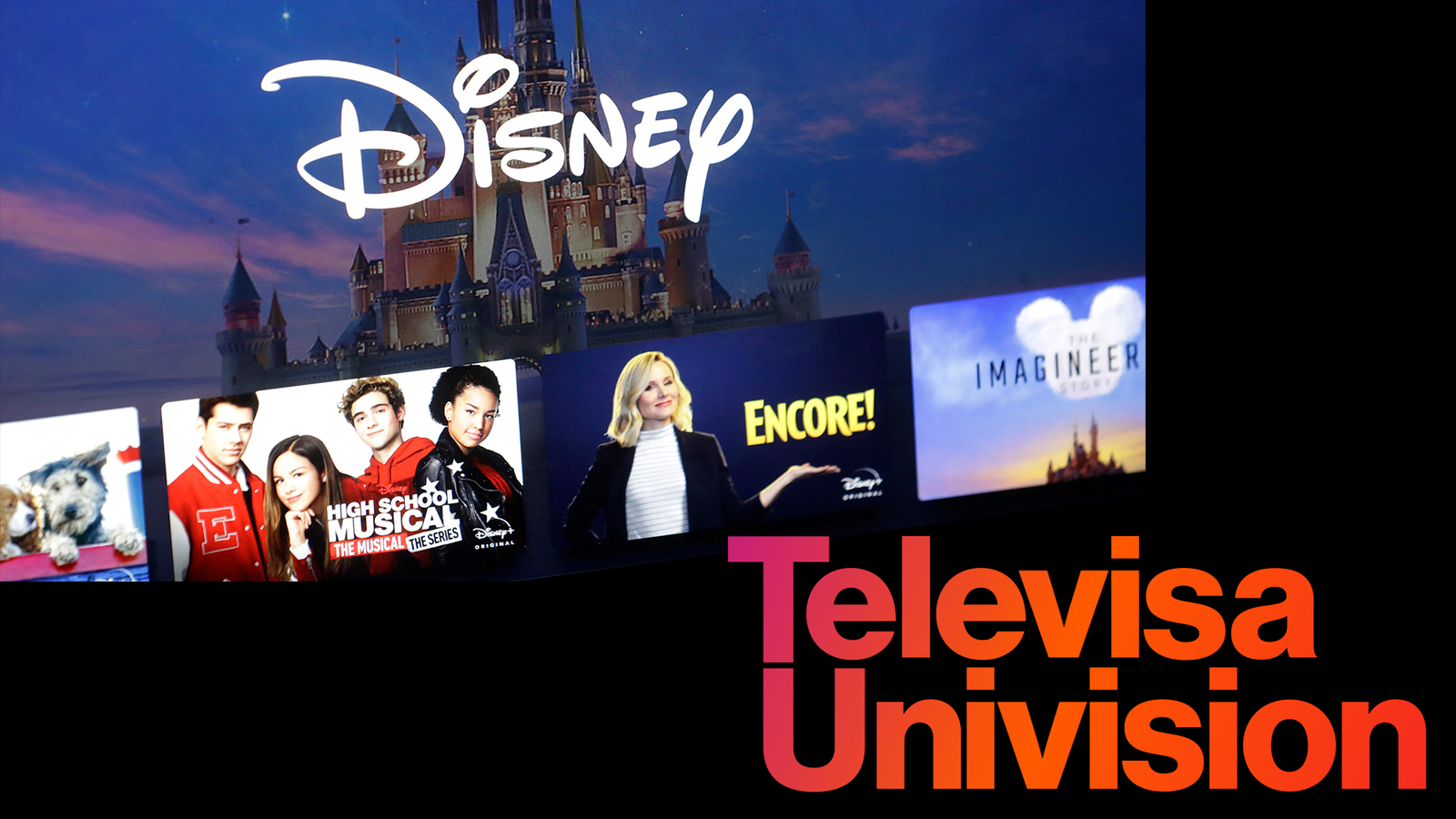
The partnership between TelevisaUnivision and The Walt Disney Company, announced in 2025, is probably the most revealing deal of this new paradigm. The agreement includes the distribution of TelevisaUnivision’s linear channels through Hulu + Live TV in the US, commercial integration between Disney+ and ViX in Mexico, and the expansion of hybrid bundles targeting Hispanic audiences.
Rafael Urbina, president of Streaming and Digital at TelevisaUnivision, described the alliance as part of a broader strategy to strengthen ViX’s connection with global Hispanic audiences. For Disney, the deal expands its footprint in Mexico through a platform with a level of cultural and territorial penetration that no standalone launch could realistically replicate in the short term.
According to Ampere Analysis, ViX was projected to become the fastest-growing streaming platform in the Americas in 2025, supported by partnerships with DirecTV, YouTube TV, Hulu, Comcast, and regional operators. ViX no longer operates as an independent platform in the traditional sense, but rather as an integrated ecosystem connected to broadcasters, operators, and technology platforms. That is precisely the model industry executives are now studying most closely.
A Strong Shift in Spain
Spain also offers compelling evidence of this transformation. Movistar Plus+, which for years maintained a relatively defensive position against the expansion of global platforms, aggressively accelerated agreements with Disney+, ARTE France, RaiPlay, and LG to expand the international circulation of Spanish fiction.
Rather than attempting to compete individually against giants with impossible-to-match budgets, the strategy shifted toward international co-productions, multi-partner projects, and content designed for global exploitation from the very beginning. Today’s Spanish series are no longer created for a single window. They are born for the global market.
If there is one sector where broadcaster-streamer integration has already moved beyond the experimental stage and become a consolidated model, it is the sports rights ecosystem.
The renewal of UEFA rights in Spain illustrates this new architecture with precision: premium competitions are now distributed across free-to-air television, traditional operators, OTT platforms, and global streamers in a structure designed to maximize reach, monetization, and simultaneous distribution windows. Movistar Plus+ retains the premium core, while RTVE preserves free-to-air exposure, and Amazon and Paramount+ continue expanding their participation across other European markets.
From Confrontation to the Hybrid Model
In this context, collaboration stopped being a theoretical option and became an operational necessity. Broadcasters, which for years had been described as dinosaurs heading toward extinction, turned out to possess assets that no global platform could quickly replicate: established local scale, proven advertising infrastructure, regulatory relationships, sports rights capable of attracting mass audiences, and a deep understanding of regional viewers that no recommendation algorithm can fully replace.
The current economic logic no longer favors extremely costly all-or-nothing bets. Instead, the industry is increasingly embracing models based on co-productions, shared licensing, staggered release windows, and multiplatform monetization.
According to Ampere Analysis, streamers are expected to reach US$101 billion in content investment in 2026 and have already surpassed traditional commercial broadcasters in share of global spending. However, the same report confirms that broadcasters remain essential across multiple territories.
The central question now being asked in boardrooms is no longer “How do we defeat the competition?” but something far more pragmatic — and much harder to answer: how do we produce premium content without individually assuming the entire financial risk?
That question is producing an increasingly clear answer. Traditional media groups still control local studios, established production capabilities, access to public funding and tax incentives, and strong positions in markets where global streamers continue to need local density and cultural relevance.
In exchange, platforms contribute financing, global reach, technology, and multiplatform distribution capabilities. The result is not a merger, but something more complex — and in many ways more interesting: a less binary and structurally interdependent ecosystem.